



A leather belt may peel when a surface coating wears away or when bonded or laminated layers separate. The appearance alone does not identify the entire belt’s material. Before buying a replacement, look for a clear description of the outer leather, backing, edges, and buckle attachment. Full-grain leather is worth considering, but no material label replaces a well-explained construction.
A belt that sheds flakes onto your clothes is frustrating, particularly if it looked substantial when new. The useful next step is to identify what is coming off. Surface finish, edge finish, backing, and the main strap are different parts, and their condition can lead to different repair or replacement decisions.
What part of the belt is actually peeling?
Look at the damaged area without pulling more material away. Is a thin colored film flaking from the broad face? Is the outer surface separating from a different-looking center? Is a strip of edge finish lifting while the main leather remains intact? Or is the backing coming away from the front?
Those observations help you describe the problem to the maker. They do not provide a laboratory identification, but they are much more useful than assuming that every belt with a damaged edge is made from the same material.
| What you see | What to investigate |
|---|---|
| Thin flakes from the belt’s broad surface | The surface coating and material beneath it |
| Distinct layers pulling apart | How the outer layer, core, and backing were joined |
| Finish lifting only at the narrow edge | The edge treatment and condition of the underlying strap |
| A crease without loose flakes | Whether this is ordinary flexing or an area of damage |
| A tear extending from a hole | Strap condition and whether continued use is appropriate |
If the strap is tearing or the buckle attachment is failing, stop relying on that belt while you arrange a replacement or ask about repair. Cosmetic flaking and a compromised fastening are different problems. A purchase decision should take account of which one you are facing.
Is peeling leather always fake leather?
No. A belt can include real leather and still have a surface finish or a joined layer that separates. Conversely, leather-like coatings on other materials can produce a similar-looking problem. You need the product’s construction information to make a more reliable distinction.
Bonded leather is also different from a continuous leather strap with an added leather backing. Our bonded leather guide explains that material category. Use that information to understand a seller’s description, rather than treating any visible seam between two layers as proof of bonded material.
The question to ask a seller is specific: “What is the outer strap made from, what is the backing or core, and how are they assembled?” A useful answer names the materials. Repeating only “genuine leather” leaves too much of the construction unexplained for a meaningful comparison.
Will a full-grain leather belt avoid the same problem?
A full-grain leather outer strap gives you a different material construction from one that relies on a leather-like surface over a bonded core. That can be a good reason to choose it when replacing a peeling belt. It still needs appropriate finishing, assembly, fit, and care.
Full-grain does not mean that a belt has no finish, no backing, no adhesive, and no parts that can wear. It also does not make the finished product immune to scratches, water damage, or excessive strain. The benefit of a clear full-grain description is knowing more about the leather you are buying, not receiving a promise that appearance will never change.
For a deeper explanation of the leather itself, see our full-grain leather guide. When choosing a replacement belt, bring that information back to the practical details: the strap, backing, edges, buckle, and how well the belt fits your clothing.
Are all layered leather belts a poor choice?
No. A layered belt can combine suitable materials for a deliberate purpose. The important distinction is what those layers are and how the finished belt is intended to perform. “Single layer good, multiple layers bad” is too broad to guide a purchase.
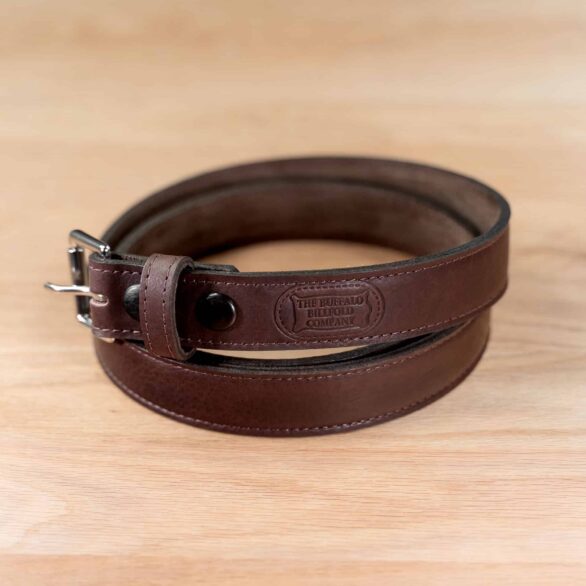
Our suede-backed full-grain leather dress belt is a useful example. The listing identifies a full-grain American Bison leather exterior, suede backing, and solid brass hardware. Its backing is an explicit design feature, rather than an unnamed layer hidden behind a generic leather claim.
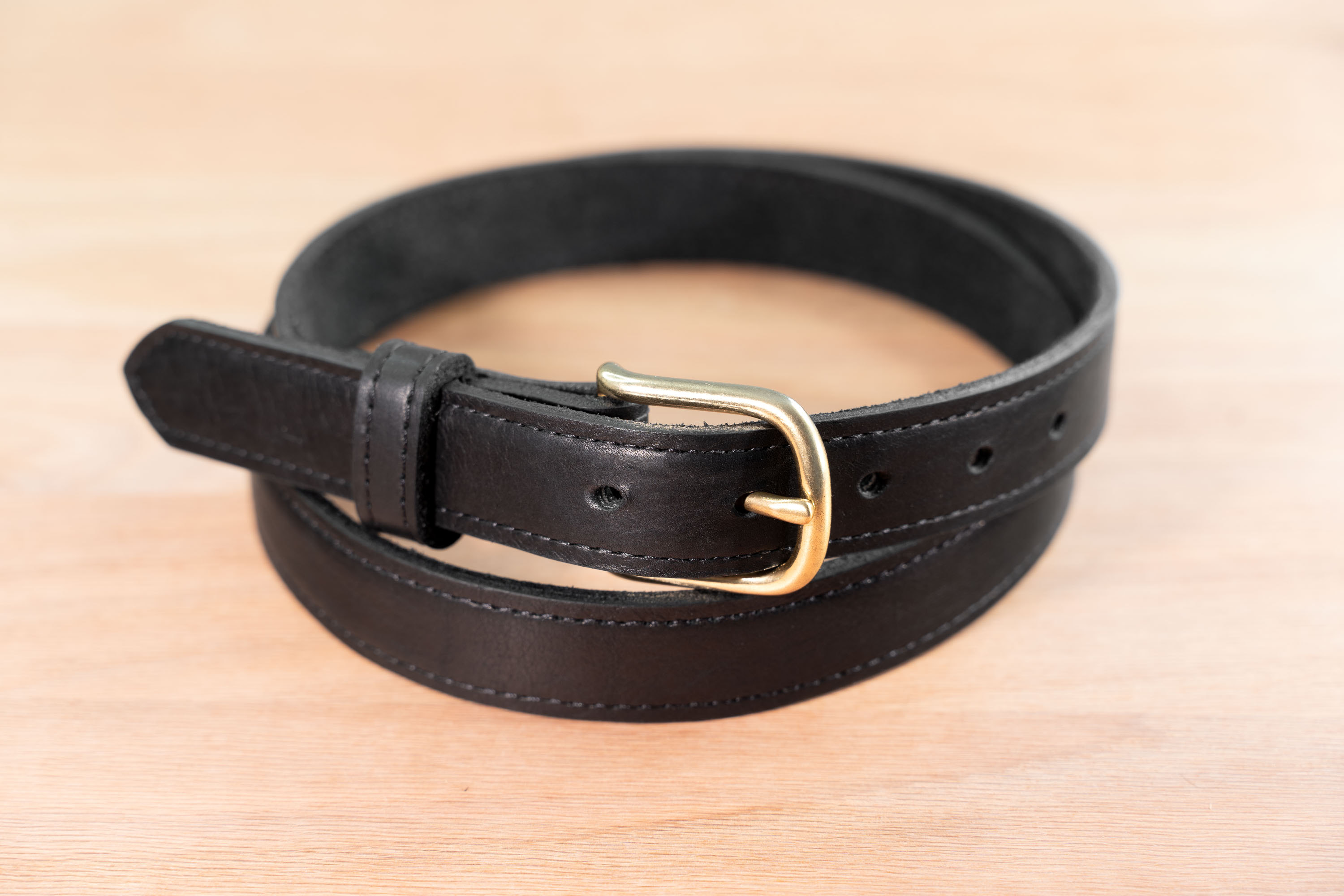
That construction should be compared on its own merits. If you prefer a suede-backed feel against your clothing, it may be a better match than another belt simply described as thick. Ask about the exact model instead of assuming that every backing will fail in the same way as the belt you are replacing.
What should you check on a replacement belt?
First, read the material description for the whole strap. Identify the exterior and any backing or core. If the details are missing, ask. You are looking for enough information to understand what you will wear, not merely a premium-sounding adjective.
Next, examine the fastening. A buckle can be riveted in place or attached with a removable arrangement. Those choices affect whether you can change the buckle and how a hardware problem might be addressed later. A replaceable component is only useful if its attachment and dimensions work with the intended replacement.
Then, match the width and size to your clothing. A well-made belt that is too wide for your loops or the wrong length is still the wrong purchase. Follow our belt measuring guide rather than assuming your trouser size directly supplies the correct belt measurement.
Finally, read the guarantee by component. Leather, buckles, finish, and normal wear may be treated differently. An explanation of what happens when a part fails is more informative than an isolated “lifetime” claim without its terms.
Which BBC belts should you compare?
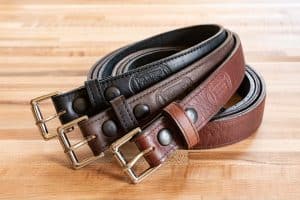
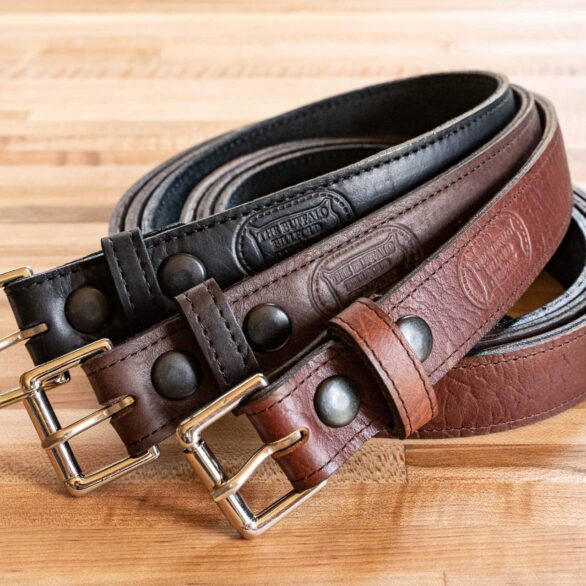
For a wider everyday option, our Bison Leather Belt is 1.25 inches wide and uses a removable nickel-plated steel roller buckle. The attachment lets you consider hardware separately from the leather strap when reviewing the design.
For a narrower option, our full-grain leather dress belt with brass buckle is 1 inch wide and uses solid brass hardware. Compare it with the suede-backed version if the inner surface and feel against your clothing are important to you.
These are different choices within our bison leather belt collection. Select between them by width, backing, appearance, and fastening. Do not assume that all BBC belts share the same buckle metal or attachment simply because they use bison leather.
Questions shoppers often ask
Can conditioner repair a peeling belt?
Conditioner does not reconstruct a missing coating or rejoin separating layers. Before applying anything, identify the material and ask the maker about the damage. A care product is not a substitute for a suitable repair or replacement.
Is a curved leather belt worn out?
Not necessarily. A belt can conform to your shape during use. A curve is different from a tear, failing attachment, or separating surface. Our guarantee discusses normal shaping and the specific conditions of coverage.
Does a thicker replacement belt always last longer?
No. Thickness alone does not identify the material or explain how the strap is assembled. Compare the complete construction and choose a width and feel that work with your clothing.
Should I repair the old belt or replace it?
Ask about repair if the problem is limited to a component that can reasonably be serviced. If the strap itself is extensively separating or tearing, a clearly described replacement may be the better route. Send the maker photos and identify the damaged part before deciding.
Start your replacement search with the construction details you wished you had known about the old belt. A named leather, an explained backing, and specific hardware give you a firmer basis for choosing the next one.

 Google
  Facebook
  Trustindex


